
● Updated April 2026 · 18 min read · By Arch. Vincent Abuya, BORAQS-Registered Architect
Building a home in Kenya is one of the most significant investments most people will make in their lifetime. It is also one of the most common sources of financial loss, stress, and disappointment — not because building in Kenya is uniquely difficult, but because the same avoidable mistakes are made over and over again. Poor budgeting. Wrong contractor. Skipped soil test. No county approval. Ignored waterproofing. These are not obscure technical failures. They are predictable, preventable, and extremely costly.
This guide, written by Arch. Vincent Abuya of Aalis Studios — BORAQS-registered architects based in Nairobi — covers the 12 most damaging mistakes Kenyans make when building a house, and exactly how to avoid each one.
The biggest mistake is starting construction without a realistic, itemised budget backed by a professional Bill of Quantities (BOQ). Most Kenyan construction projects that stall, run out of money, or deliver poor results can trace the root cause to a budget that was guessed at rather than prepared properly. A detailed BOQ — produced by a qualified professional before work begins — is the most important document in any Kenyan construction project.
- Starting Construction Without a Clear Budget
- Buying Land Without Proper Site Evaluation
- Not Hiring an Architect Early Enough
- Choosing a Contractor Based on Price Alone
- Ignoring County Approvals and Compliance
- Underestimating Finishing and Interior Costs
- Poor Space Planning and Room Proportions
- Failing to Plan for Waterproofing and Drainage
- Building Without Proper Project Management
- Skipping the Soil Test and Geotechnical Survey
- Designing Only for Today and Not the Future
- Managing the Project Yourself Without Experience
- 01 · Starting Without a Clear Budget
- 02 · Buying Land Without Site Evaluation
- 03 · Not Hiring an Architect Early Enough
- 04 · Choosing Contractor by Price Alone
- 05 · Ignoring County Approvals
- 06 · Underestimating Finishing Costs
- 07 · Poor Space Planning
- 08 · Waterproofing and Drainage Failures
- 09 · Building Without Project Management
- 10 · Skipping the Soil Test
- 11 · Designing Only for Today
- 12 · Self-Managing Without Experience
- How to Avoid These Mistakes — Checklist
- Why Professional Guidance Saves Money
- Frequently Asked Questions
Starting Construction Without a Clear Budget
Most Kenyan construction projects that stall, spiral out of control, or deliver disappointing results share a common root cause: the budget was never properly established before work began. This is the single most damaging mistake in Kenyan residential construction — and it is entirely preventable.
A "budget" in Kenya too often means a rough figure a client has in their head, sometimes taken from what a neighbour spent several years ago. It rarely accounts for the real total: construction, finishes, professional fees, county approval costs, external works, utility connections, and the contingency that every project in Kenya genuinely needs. When the gap between the imagined budget and the real cost becomes apparent mid-construction, projects stall — sometimes permanently.
Research finding: Construction projects that start without a professional Bill of Quantities (BOQ) are estimated to run 20–40% over budget on average in Kenya, according to quantity surveying professionals surveyed by the Institute of Quantity Surveyors of Kenya (IQSK). The most common single cause of project abandonment in Kenya is running out of funds mid-construction.
How to Avoid This Mistake
Buying Land Without Proper Site Evaluation
Land in Kenya is bought in excitement and evaluated in hindsight. Many homeowners acquire a plot based on price, location, and the seller's assurances — then discover after purchase that the land has a legal dispute, sits in a flood zone, has poor access, requires expensive foundation treatment, or falls within a restricted planning zone that prevents the type of development they intend.
A proper site evaluation is not expensive. It is a fraction of what it costs to resolve land problems discovered after purchase — or worse, during construction.

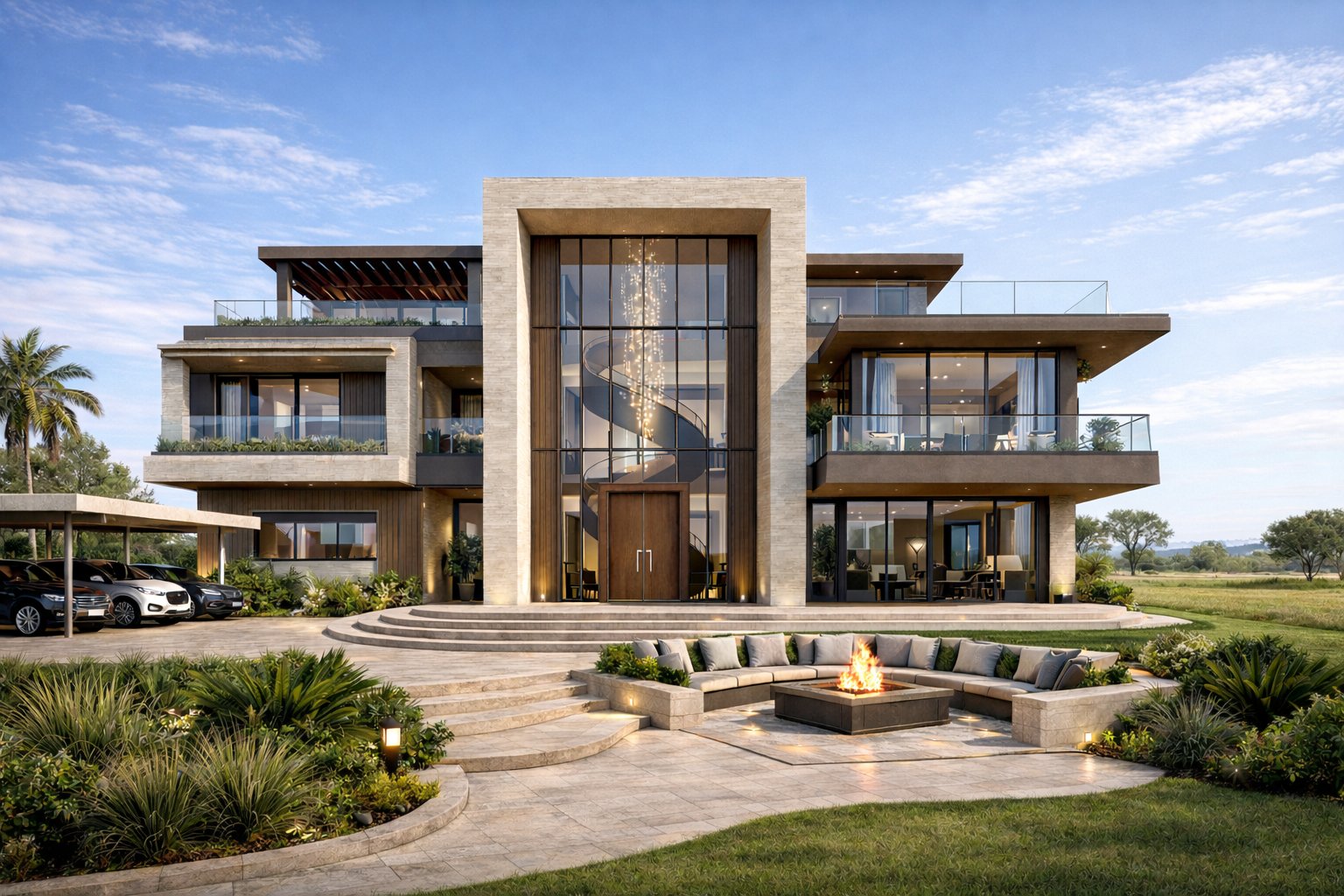
Proper site evaluation before purchase allows architecture to work with the land — not against it
What a Proper Site Evaluation Covers
Not Hiring an Architect Early Enough
One of the most persistent myths in Kenyan construction is that you hire an architect after you know what you want — to draw up what you have already decided. In reality, the architect's most valuable contribution happens before any decisions are locked in: in the site visit, the feasibility conversation, the early cost reality-check, and the spatial planning that shapes how your home actually feels to live in.
When clients come to architects late — with a contractor already in place, or with plans copied from a neighbour — the design decisions that drive 80% of the construction cost and 100% of the long-term experience of the home have already been made poorly.
Under Kenya's Architects and Quantity Surveyors Act (Cap. 525), BORAQS-registered architectural drawings are legally required before any county council will process a development application. Building without approved plans exposes you to stop-work orders, demolition notices, and building insurance voidance. Learn about BORAQS-registered architectural design from Aalis Studios.
What Happens When You Hire Late
Copied plans — downloaded online or taken from a neighbour's house — are not county-submission ready, do not account for your specific plot's setbacks, drainage, and orientation, and frequently produce homes with poor natural light, uncomfortable room proportions, inadequate storage, and wasted circulation space. The architect's design fee, which at Aalis Studios is 3% of estimated construction cost, is one of the most cost-effective investments you can make — not a cost to minimise.
"The cheapest thing about a well-designed house is the architect's fee. The most expensive thing about a poorly designed house is living in it."
Arch. Vincent Abuya, Principal Architect — Aalis StudiosBeyond legality and aesthetics, an architect engaged early can steer you away from structural decisions that become costly later — oversized rooms that inflate the foundation area, complex roof shapes that triple roofing cost, or window configurations that drive up glazing expenditure without improving the space. Good architectural design saves money throughout the build, not just at the design stage.
Your Project Goes Any Further.
Choosing a Contractor Based on Price Alone
The lowest quote is almost never the cheapest outcome. In Kenya's residential construction market, a dramatically low quote typically signals one or more of the following: the contractor has excluded key items from their scope, they plan to use cheaper materials than specified, they are planning to substitute skilled labour with unqualified fundis, or they are pricing aggressively to win the job with the intention of recovering margin through uncontrolled variations once they are on site.
Contractor disputes, abandonments, and poor workmanship are among the leading causes of project failure in Kenya. In many cases, the cost of rectifying poor construction work exceeds the money saved by choosing the cheaper contractor in the first place.
| Factor | Poor Approach | Professional Approach |
|---|---|---|
| Selection basis | Lowest price quote | Competitiveness against BOQ |
| Contractor credentials | Unverified / word of mouth | NCA-registered, references checked |
| Contract terms | Verbal or informal agreement | Written contract with programme and penalties |
| Payment structure | Large upfront payments | Milestone-based, never >30% upfront |
| Site supervision | Self-supervised or unsupervised | Independent professional oversight |
| Material sourcing | Contractor buys materials unsupervised | Client or PM approves all major material purchases |
| Common outcome | Variations, disputes, stalls, rework | Delivered to programme and budget |
How to Vet a Contractor in Kenya Properly
Ignoring County Approvals and Compliance Requirements
In a rush to start building, some Kenyan homeowners skip or delay the approval process — assuming it is bureaucratic inconvenience that can be resolved later. This is a serious and potentially catastrophic mistake. County governments in Kenya have the legal authority to issue stop-work orders on unapproved developments, impose significant fines, and require partial or complete demolition of non-compliant structures.
Beyond the immediate risk, building without county approval means you cannot get an occupation certificate, which may affect your ability to sell the property, obtain building insurance, or secure lending against it in the future.
What you need before breaking ground in Kenya: (1) County development permission — submitted with BORAQS-stamped architectural drawings. (2) NCA project registration for qualifying projects. (3) NEMA EIA licence if applicable to your project type or scale. Your architect handles these submissions — but only if you engage them early enough.
What the Approval Process Involves
Development permission in Kenya is applied for at the relevant county government physical planning department. The application requires BORAQS-stamped architectural drawings, structural drawings, a site plan showing plot boundaries and setbacks, proof of land ownership, and payment of county application fees. In Nairobi, this is processed through the Nairobi City County. In satellite towns like Kiambu, Thika, Machakos, and Kitengela, each county has its own process and timeline.
Approval typically takes 4–10 weeks in Nairobi and other major counties, though timelines vary. Engaging your architect early means the design and approval processes run in parallel with site preparation — minimising overall project delays rather than creating them.
Underestimating Finishing and Interior Costs
Interior finishes are the most consistently underestimated cost category in Kenyan residential construction. Most budget discussions focus on the structure — the foundation, walling, columns, roof slab, and roof covering. These are important, but finishes typically account for 25–40% of the total project cost and have a far greater impact on how the home actually feels and functions day to day.




Interior finishes — from kitchen joinery and flooring to bathrooms and lighting — are the largest variable in total project cost and the category most consistently underestimated at the planning stage
The Finishing Items Most Often Forgotten in Budgets
Poor Space Planning and Room Proportions
A house that looks good in a floor plan can feel wrong to live in. Poor space planning in Kenya often manifests as: living rooms that are generously proportioned but never feel comfortable; bedrooms that are too small for reasonable furniture arrangement; corridors that consume 8–12% of the floor area without contributing usable space; and kitchens designed without regard for how anyone actually cooks or moves through them.
These are not cosmetic problems. They affect daily quality of life for as long as you live in the house, and they meaningfully reduce resale value. Space planning is one of the most valuable things a good architect does — and one of the first things compromised when plans are copied, downloaded, or designed without professional input.
Common Space Planning Mistakes in Kenya
Oversized formal sitting rooms that are used once a year but consume a third of the ground floor. Master bedrooms without sufficient space for a king bed, side tables, and a walk-through path to the bathroom. No storage — no linen cupboard, no broom space, no utility area. Secondary bedrooms that are functionally identical but given to teenagers who need desk space and privacy. A kitchen positioned so that the cook is physically isolated from the family during meal preparation.
Good space planning addresses all of these before a single drawing is produced — by understanding how your family actually lives and translating that into proportions and adjacencies that work. This is an architectural conversation, not a drafting exercise.
Failing to Plan for Waterproofing and Drainage
Waterproofing is the construction decision whose consequences are most felt after the project is complete, not during it. A house with inadequate waterproofing in Kenya will leak, show damp patches on walls, suffer rising dampness at ground floor level, experience cracked render and spalling plaster, and develop mould problems that affect both the building fabric and the health of the people living in it. Repair costs are disproportionately high — because fixing waterproofing after construction often requires removing finishes, breaking into walls, or relaying entire roof sections.

Proper roof overhangs, correct drainage gradients, and quality waterproofing membranes prevent the expensive repair cycles that plague poorly specified Kenyan buildings
Where Waterproofing Failures Happen in Kenya
Building Without Proper Project Management
Construction is a complex, multi-trade process that requires constant coordination between the structural contractor, plumber, electrician, roofer, carpenter, and finishes teams. When these trades work independently — each arriving and leaving according to their own schedule without coordination — the result is out-of-sequence work, damage to completed elements, unnecessary delays, and significant material wastage.
On a self-managed Kenyan construction site without professional project management, it is common to see electrical conduit installed after plastering has begun (requiring channelling of already-plastered walls), plumbing laid without proper gradients, roof work starting before the structural columns have achieved sufficient concrete strength, and finishing trades beginning in rooms before the building is properly weathertight.
What Professional Project Management Prevents
Skipping the Soil Test and Geotechnical Survey
Kenya has some of the most geologically varied terrain in East Africa. Black cotton clay soil — common across parts of Nairobi, Kiambu, Kitengela, Athi River, and Kisumu — expands significantly when saturated and contracts when dry. This seasonal movement creates differential foundation settlement that causes structural cracking, door and window frames distorting, floor slabs heaving, and in severe cases, significant structural damage. Sandy soils in coastal areas have poor load-bearing capacity. Rocky ground in Thika and Murang'a increases excavation costs significantly. Murram soils in central Kenya are generally stable but vary in bearing capacity.
A geotechnical soil investigation — involving trial pits, soil classification, and bearing capacity assessment — costs between KSh 30,000 and KSh 80,000 depending on site size and number of test points. The structural engineer uses this information to design the foundation correctly for your specific soil conditions. Skipping this step and designing foundations based on assumed conditions regularly costs clients KSh 500,000–2,000,000 in remedial foundation work, or worse, results in structural damage that compromises the safety and value of the entire building.
A soil test is non-negotiable. In black cotton soil areas — including parts of Nairobi South, Kitengela, Athi River, and sections of Kiambu — failing to conduct a proper geotechnical investigation and design foundations accordingly is one of the most common causes of structural cracking in Kenyan residential buildings. The Institute of Engineers of Kenya (IEK) consistently identifies skipped geotechnical investigations as a root cause of building failures nationally.
Designing Only for Today and Not the Future
A house built in 2026 should still be working well for you in 2046 — but many Kenyans design exclusively for their current household without considering how their needs will change. Children grow and need more privacy. Elderly parents may eventually need accessible facilities. Remote work has created a genuine need for a home office space that most plans produced before 2020 did not accommodate. The rental potential of a DSQ or a self-contained ground floor unit can meaningfully improve the financial performance of your property investment.
Future-Proofing Elements Worth Planning For
Self-Managing the Project Without Construction Experience
Construction project management is a professional discipline that requires simultaneous management of design, procurement, labour, materials, sequencing, quality control, safety, cost, programme, and stakeholder relationships. It is not something that can be effectively self-taught in real time while your life savings are invested in the outcome on site.
The costs of self-management in Kenya are well-documented in practice: materials procured at retail prices rather than contractor rates; trades not coordinated and arriving out of sequence; no documentation of what has been agreed, making variations impossible to manage; and no professional advocate when the contractor behaves badly. The savings from cutting professional project management fees — typically 3–5% of construction cost — are routinely lost many times over in the inefficiencies it prevents.
This is particularly true for diaspora clients building in Kenya from the UK, USA, Canada, or Australia. The distance, the time difference, and the inability to visit the site regularly make professional on-the-ground management not a luxury, but a necessity. Aalis Studios' diaspora build service is built specifically to address this — with weekly site reports, photorealistic 3D approvals, and a named project manager as your single contact throughout.
How to Avoid These Mistakes: A Practical Checklist
Before you commit a single shilling to construction in Kenya, work through this checklist. Every item here represents a real mistake that has cost Kenyan homeowners millions of shillings — and every one of them is preventable.
- Conduct an official title search at the county Land Registry
- Verify land rates are paid and the title is clean of encumbrances
- Check the planning zone designation and permitted development rights
- Confirm road access and proximity to Kenya Power and water mains
- Engage a lawyer for the purchase transaction — not just a broker
- Engage a BORAQS-registered architect for a site visit and feasibility assessment
- Commission a geotechnical soil investigation before designing foundations
- Establish a realistic total project budget — including finishes, fees, external works, and contingency
- Discuss future needs: DSQ, home office, solar readiness, potential future floor
- Confirm county setback requirements before fixing the house footprint
- Obtain county development permission — do not start without approved drawings
- Commission a professional Bill of Quantities before issuing tender to contractors
- Get at least three priced BOQs and compare item by item, not just by total
- Verify contractor NCA registration and check at least three recent project references
- Sign a formal written contract with programme, payment schedule, and penalties
- Never pay more than 30% of the contract sum as an upfront advance
- Maintain professional site supervision — never rely on the contractor to self-supervise
- Inspect and approve all concealed elements before they are covered: reinforcement, waterproofing, MEP
- Manage all variations through a formal written change order process
- Visit the site regularly — or receive weekly photographic reports if you are abroad
- Do not pay variations informally — insist on a written variation order and agreed cost before approval
Why Professional Design and Build Guidance Saves Money
Every mistake in this guide is preventable with proper professional guidance. This is not a sales argument — it is a financial one. The cost of architectural and professional services in Kenya — typically 8–15% of total project cost — is consistently recovered many times over through:
A well-designed, professionally managed project delivers a home that functions beautifully, holds its value, and was built without the costly mistakes that characterise self-managed construction
Frequently Asked Questions About Building Mistakes in Kenya
Building in Kenya? Get Professional Guidance Before You Commit.
Aalis Studios offers architecture, interior design, cost planning, approvals guidance, construction management, and full design-build delivery across Kenya. Whether you have a plot, a design, or just an idea — our consultation gives you a clear, honest next step.