Your compound is the first thing anyone sees when they arrive at your home — and the space your family lives in every day. Yet in most Kenyan homes, the compound remains an afterthought: a patch of grass that floods in the rains, a driveway that turns to mud, a boundary wall with nothing growing against it. Compound landscaping is the practice of changing that — transforming the outdoor space around your house into something as considered, functional, and beautiful as your interior.
In 2026, compound landscaping is the fastest-growing home improvement category across Nairobi and beyond. Homeowners who invest in their compound see measurable returns: higher property values, lower maintenance costs, and a home that genuinely feels like a lifestyle upgrade every day. This guide gives you everything: what good compound design actually involves, plot-size-specific layout ideas, real 2026 costs, the best plants for Kenya, how to avoid the most common mistakes, and the three AALIS compound design packages that have transformed hundreds of Kenyan homes.
This guide covers the full compound design approach. For specific outdoor structures, see our dedicated guides: Gazebo Designs Kenya 2026 and Pergola Designs Kenya 2026. For the complete outdoor spaces overview, see Outdoor Spaces Kenya 2026.
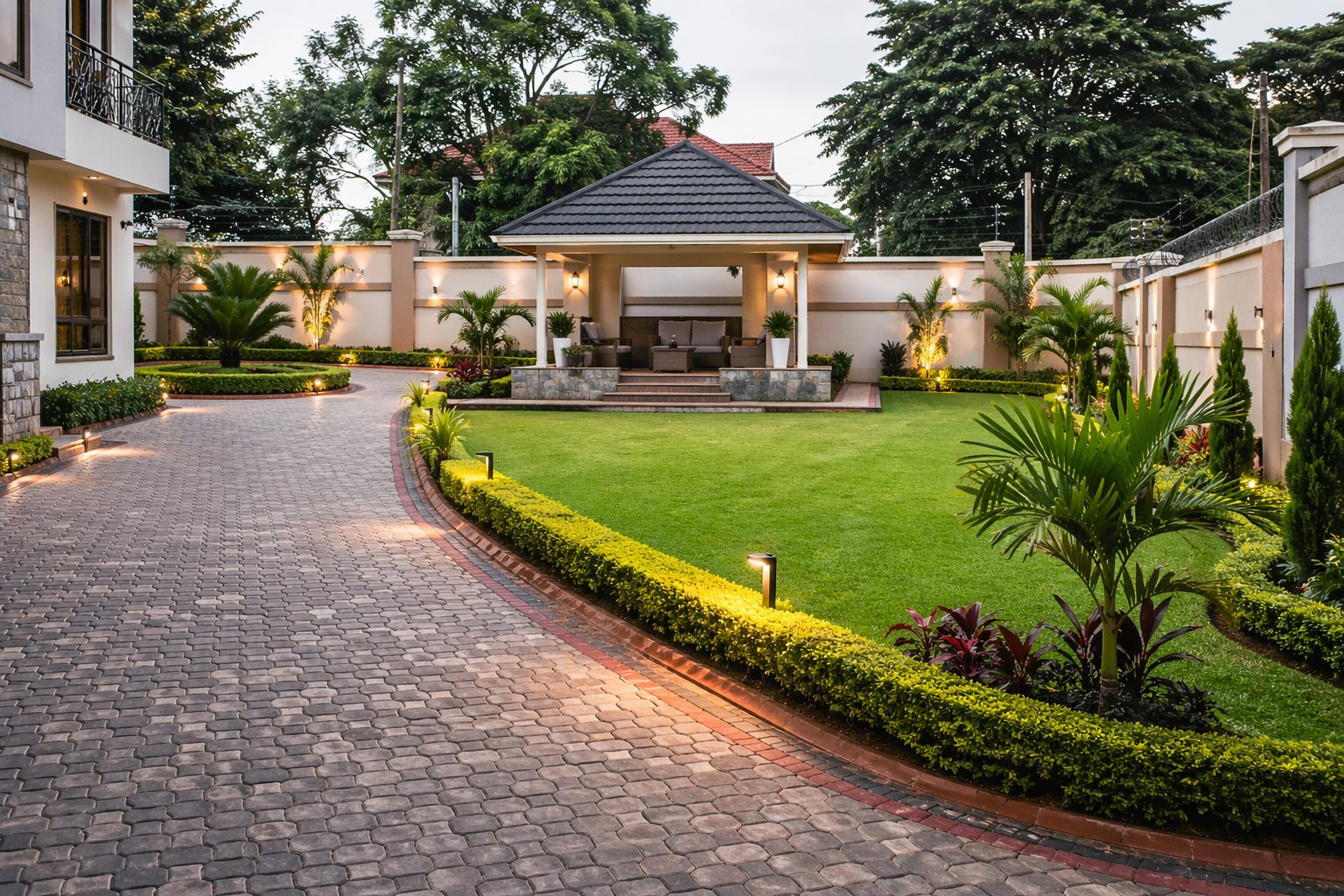
What Does Compound Landscaping Really Mean in Kenya?
Many homeowners think of landscaping as simply planting a few flowers and mowing the grass. Professional compound landscaping is far more comprehensive — it is the complete design and installation of your entire outdoor environment, integrating both hardscaping (permanent structures and surfaces) and soft landscaping (living plants, trees, lawn, and hedges) into a coherent, functional whole.
A properly designed compound addresses six things simultaneously: how people move through the space, where water goes when it rains, what creates privacy from the street and neighbours, how the space looks at different times of day and night, what is low-maintenance in Kenya's climate, and how the outdoor space connects to and enhances the house itself.
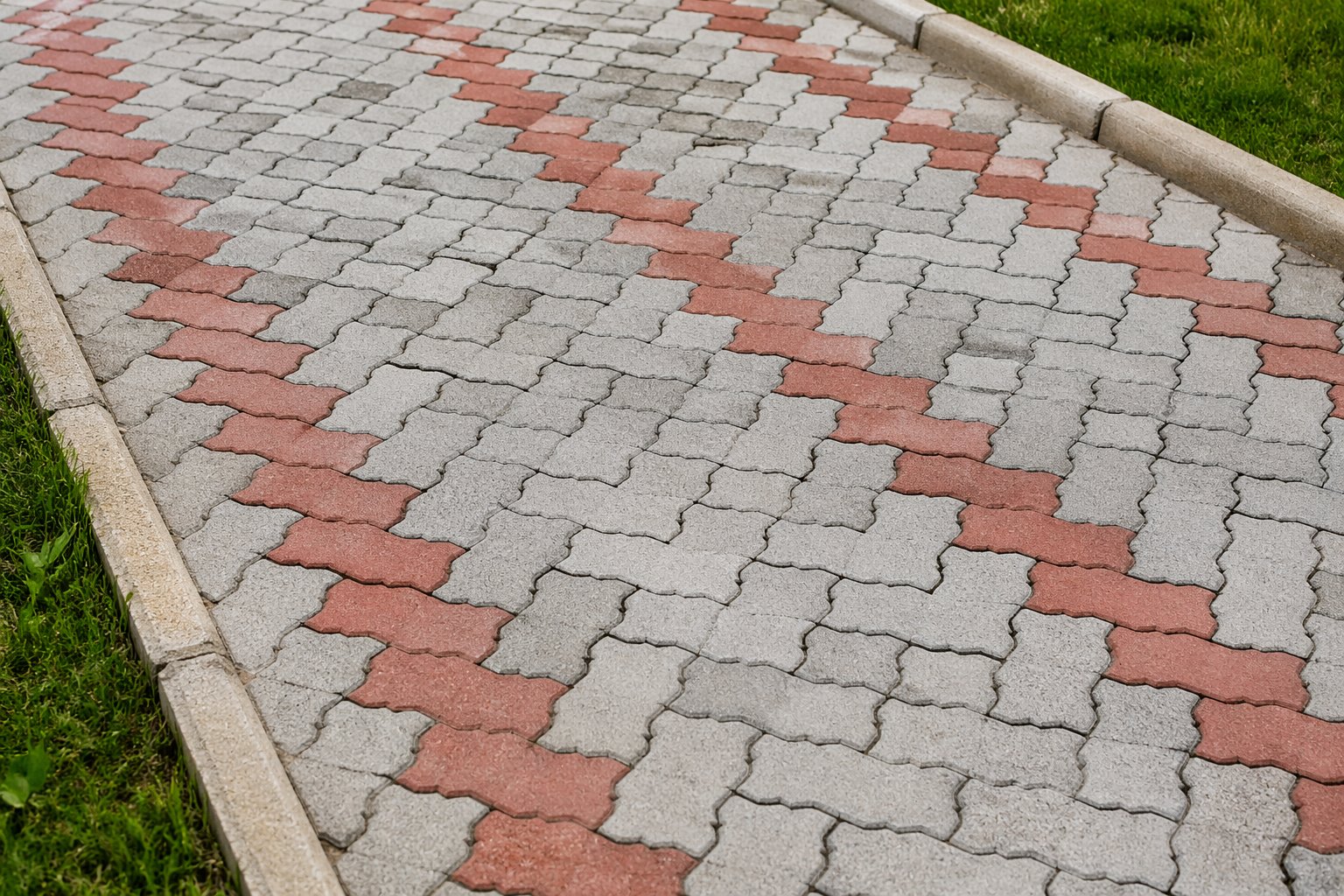
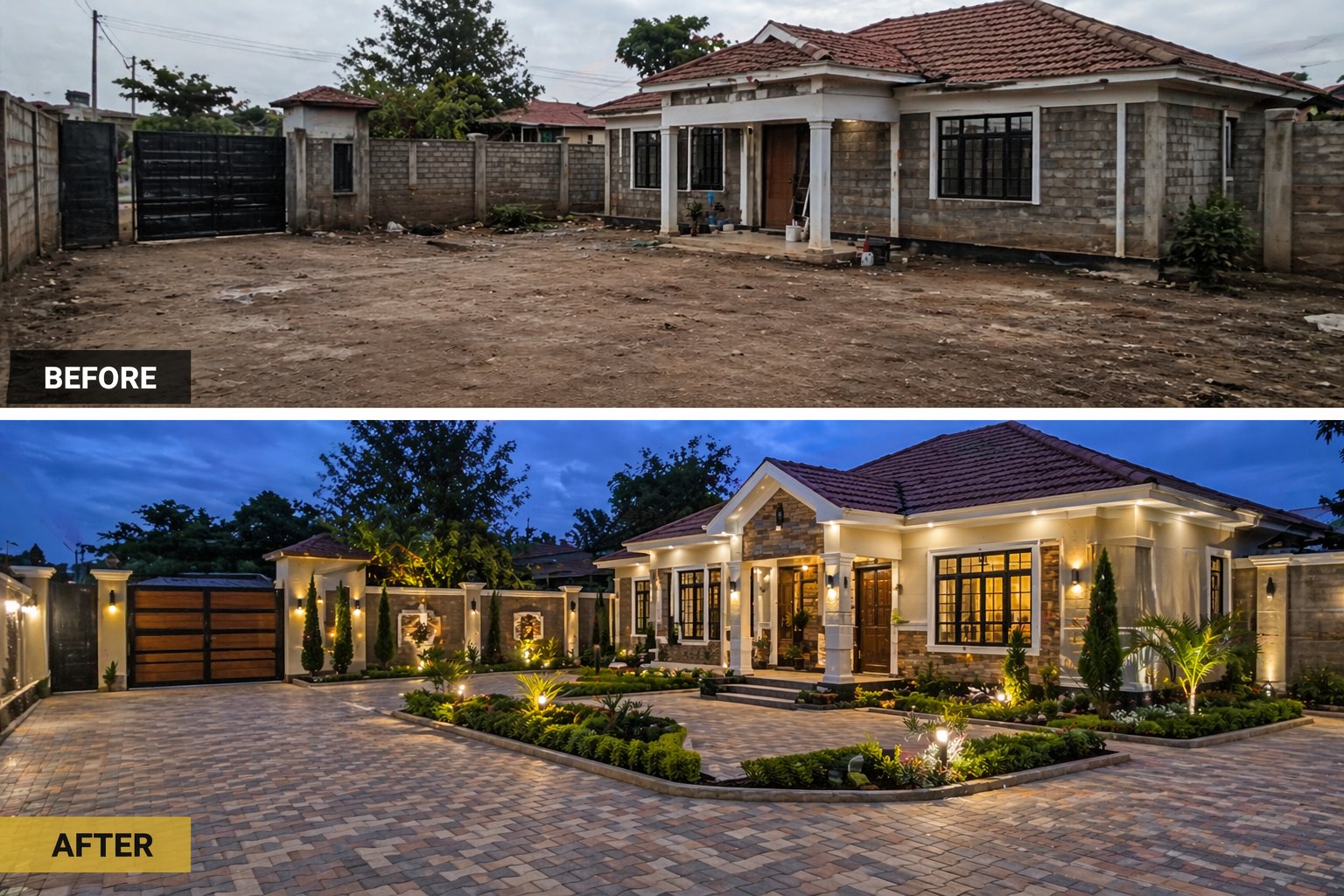
Driveways, pathways, and entertainment zones. Essential for rain-season functionality. Available in grey, red, and charcoal block patterns.
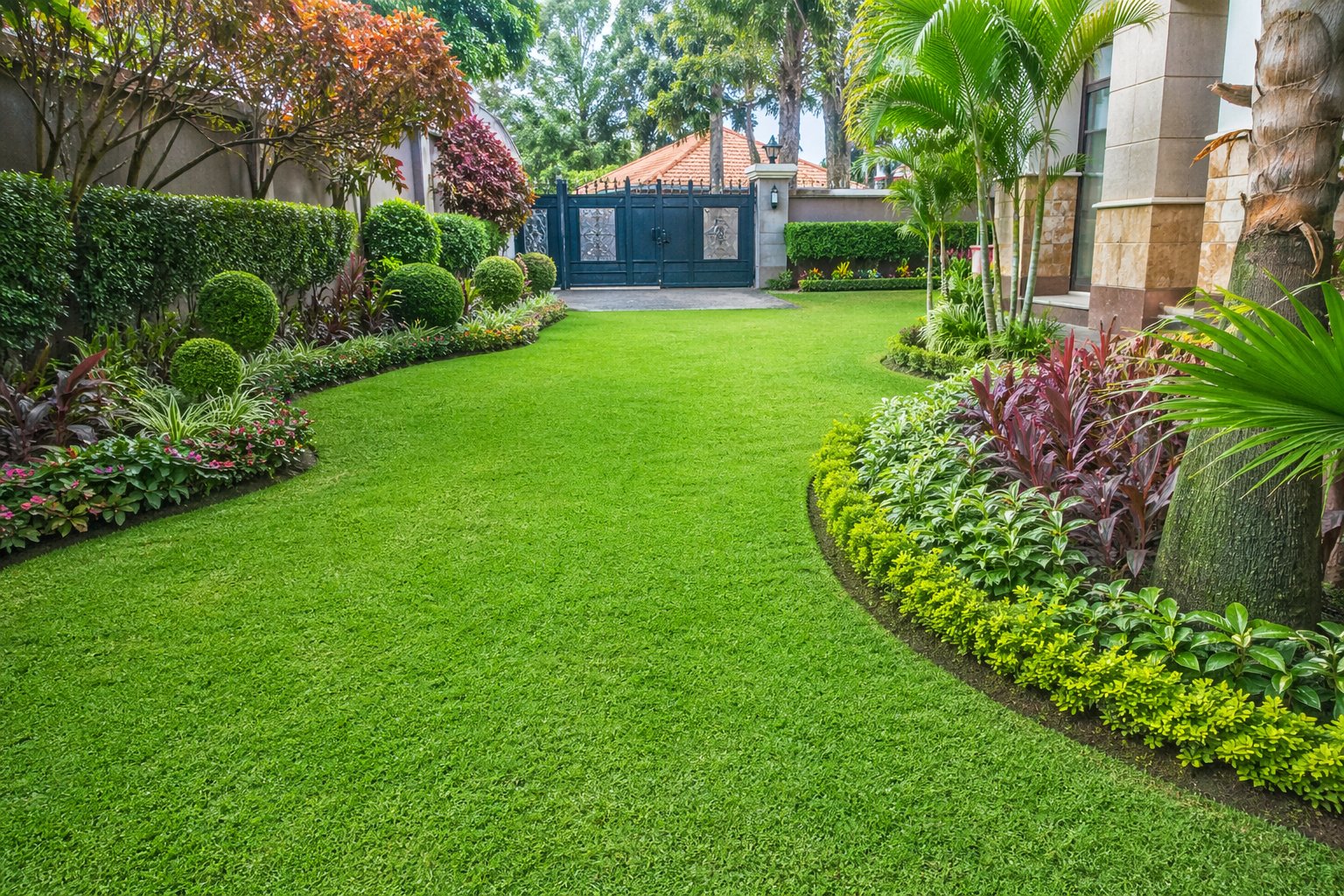
Arabica or Kikuyu grass for central open areas. Creates the visual anchor of the compound. Requires monthly maintenance or automatic irrigation.
Colourful ornamental plants along boundaries, driveways, and entry areas. Bougainvillea, crotons, canna lilies, and hibiscus are Nairobi favourites.
Shade trees for long-term value, Kei Apple or Bougainvillea for perimeter security hedging. The structural backbone of the compound design.
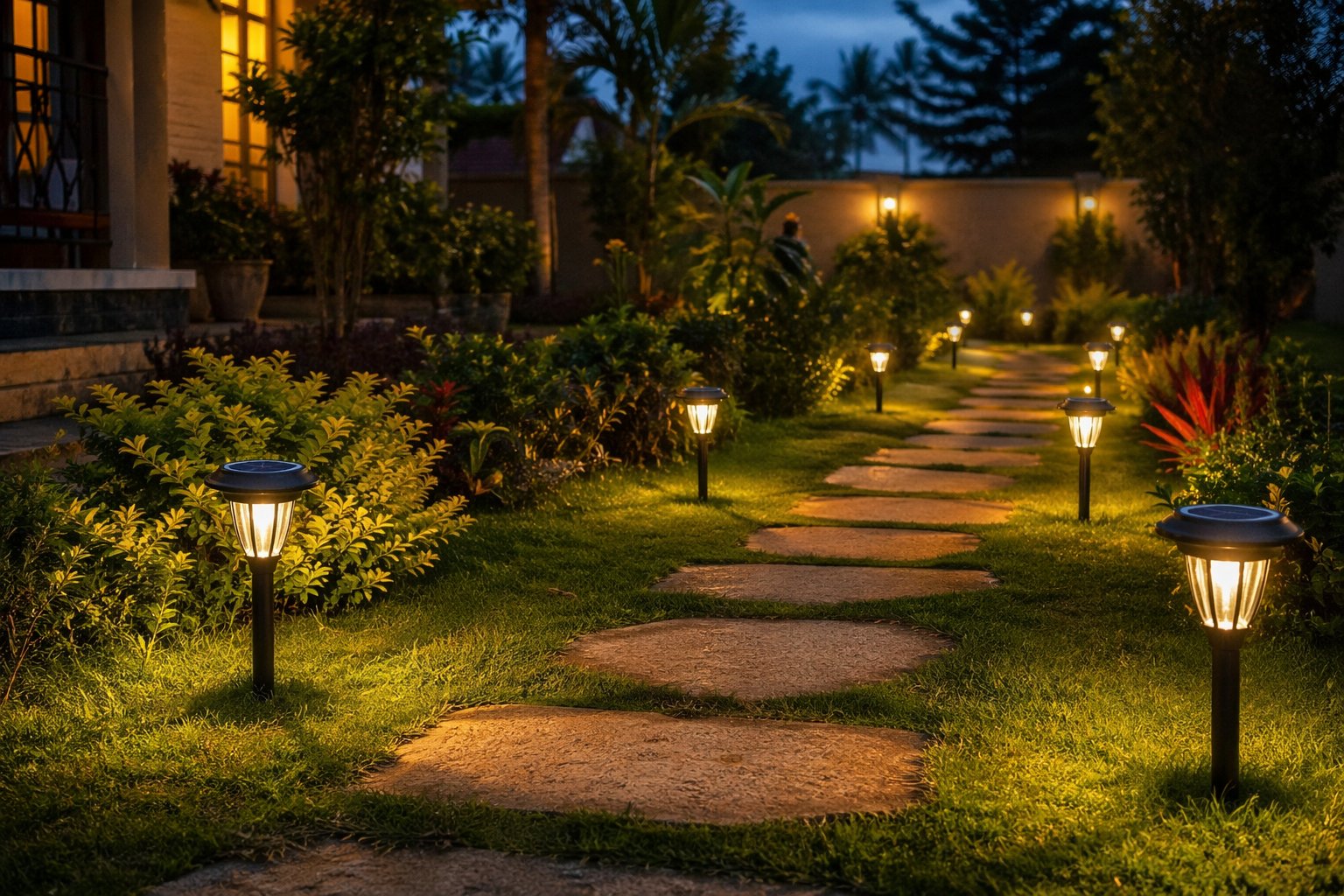
Solar pathway spikes, feature uplights on trees, and string or LED lights over entertainment areas. Transforms the compound after dark at minimal cost.
Mazeras stone, river stones, or stepping stones through garden areas. More affordable than cabro and visually warmer for garden paths and side access routes.
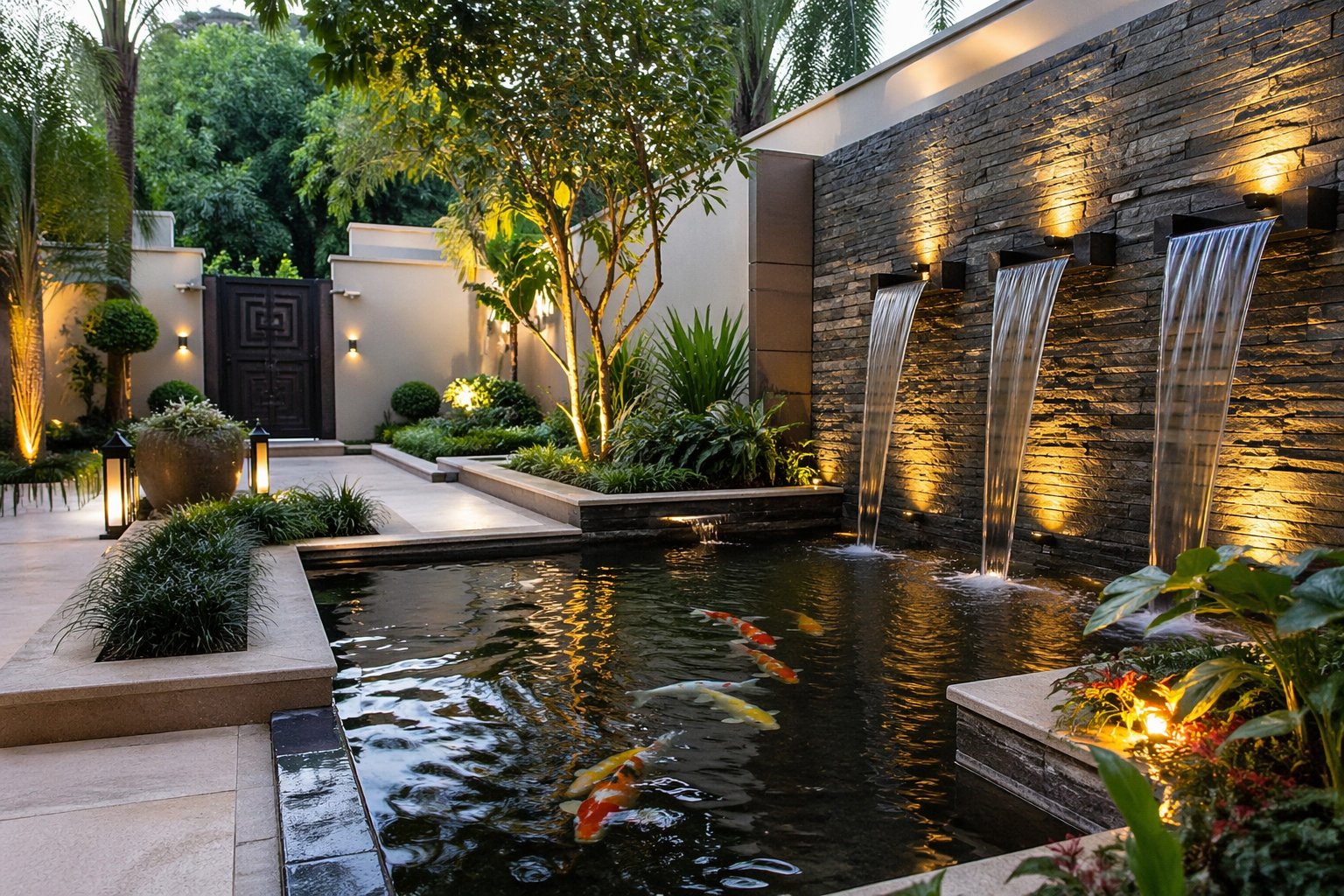
Wall fountains, koi ponds, or small waterfalls. Adds ambient sound, cools the environment, and creates a premium focal point in mid-to-high-end designs.
Raised beds or ground-level edible planting along boundary walls. Passion fruit, herbs, sukuma wiki, and tomatoes. Reduces household costs and adds daily use.
Automated watering system for lawns and planting beds. Ensures plants survive Kenya's dry seasons without manual daily watering. Essential for premium compounds.
Compound Landscaping by Plot Size — Kenya 2026
The right compound design depends first on your plot size. The same approach that works beautifully on a quarter-acre in Karen will overwhelm a 30×60 townhouse plot in Ruiru. Here is a practical, honest guide to what you can achieve — and what it costs — at each of Kenya's most common residential plot dimensions.
×60
After county setbacks and the house footprint, a 30×60 plot leaves limited outdoor space — typically 60–90 m². The design philosophy is vertical first, ground second. A paved stone or gravel pathway from the gate to the front door is the most impactful single improvement. Add wall-mounted vertical planters or a trellis with climbing bougainvillea against the boundary wall for greenery without ground footprint. A compact patch of artificial turf or Arabica grass (10–15 m²) near the entry creates a polished, hotel-like arrival. Solar spike lights along the path complete the night-time aesthetic. Avoid overcrowding small spaces with too many elements — restraint makes small compounds feel larger.
×80
A 40×80 plot allows for a more structured compound layout. After setbacks, approximately 150–180 m² of usable outdoor space remains. The recommended approach is functional zoning: a cabro-paved driveway at the front with grass borders, a small gazebo or pergola in the rear corner for outdoor seating, a kitchen herb garden along one side wall, a perimeter live hedge of Yellow Oleander or Duranta for privacy, and ornamental border plants (bougainvillea, hibiscus, crotons) along the front garden beds. A single shade tree — Nandi Flame or Jacaranda — near the rear boundary provides long-term visual impact and shade for the entertainment area. Decorative white pebbles around flower beds reduce weeding and add a clean, modern contrast.
×100
Kenya's most common residential plot size offers genuine outdoor design potential. With 250–300 m² of usable outdoor area after setbacks, you can create multiple defined zones. The recommended AALIS layout for a 50×100 plot: a cabro-paved driveway with planted grass strips; a stone pathway from the gate through to the front door; a front entry garden with ornamental planting and seasonal flowers; a rear gazebo or timber pergola as the entertainment anchor; a central lawn area for family use; a kitchen garden with raised beds along one boundary wall; a Kei Apple or bamboo live hedge along the perimeter; and solar pathway lighting throughout. The entry gate and driveway create the first impression — invest here first before the rear garden. Fruit trees (avocado, mango) along the rear boundary add long-term edible value and shade.
acre
+
A quarter-acre and above unlocks true multi-room compound living. The outdoor space is designed as a series of connected garden rooms, each with a distinct character and purpose. A formal entry garden with manicured hedging and statement planting creates arrival impact. A covered entertainment terrace or large gazebo becomes the outdoor living room. A fire pit lounge creates the evening social anchor. A dedicated kitchen garden or greenhouse provides fresh produce year-round. An open lawn accommodates events and family gatherings. A water feature — koi pond, wall fountain, or cascading waterfall — provides the focal point and ambient sound that elevates the entire space. Privacy comes from living fences of Kei Apple, Bougainvillea, or bamboo. Retaining walls and terracing on sloped plots in Ngong, Kikuyu, Limuru, and Kijabe manage the terrain and create visual interest. A drip irrigation system (KES 25,000–120,000) and professional lighting design complete the transformation.
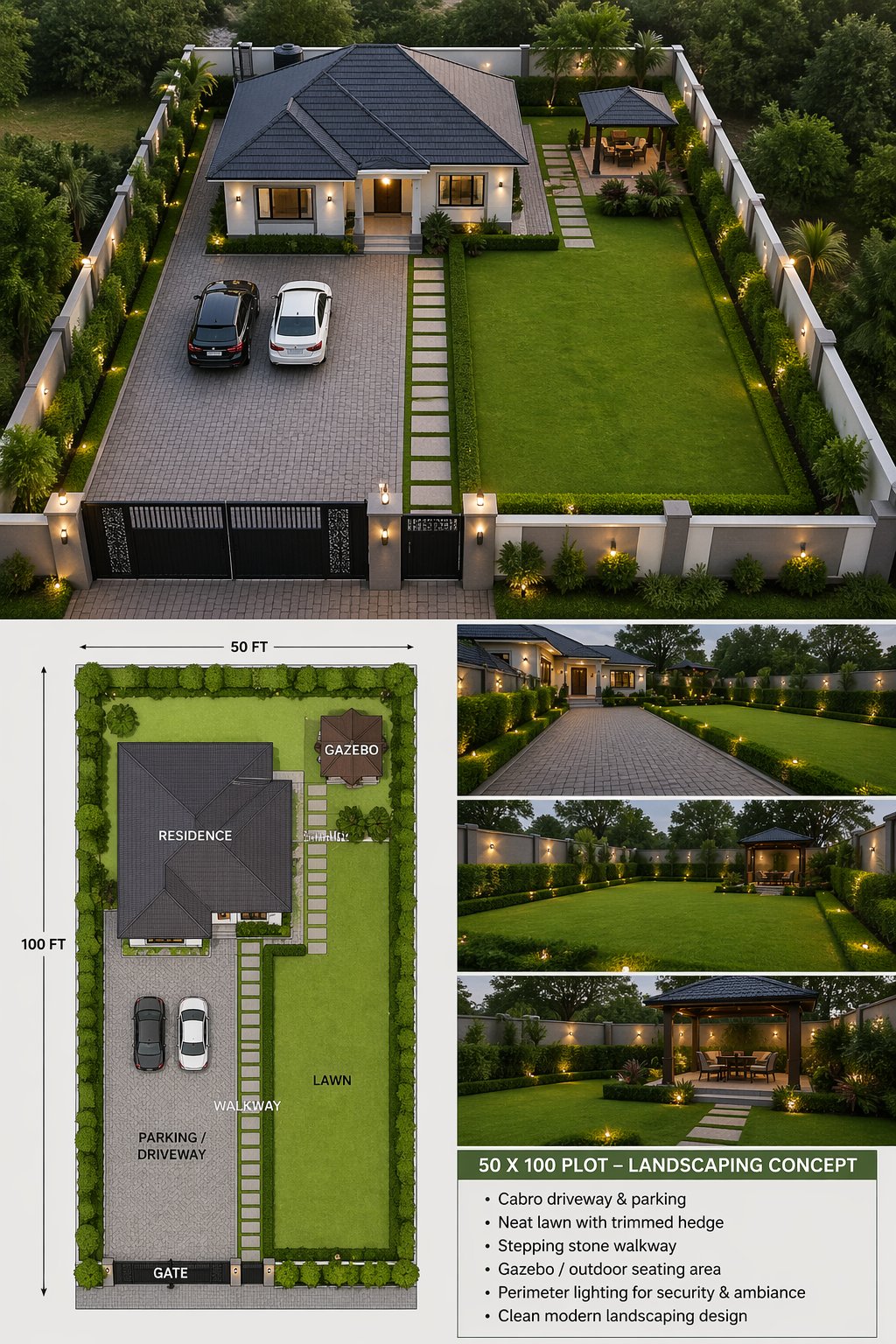
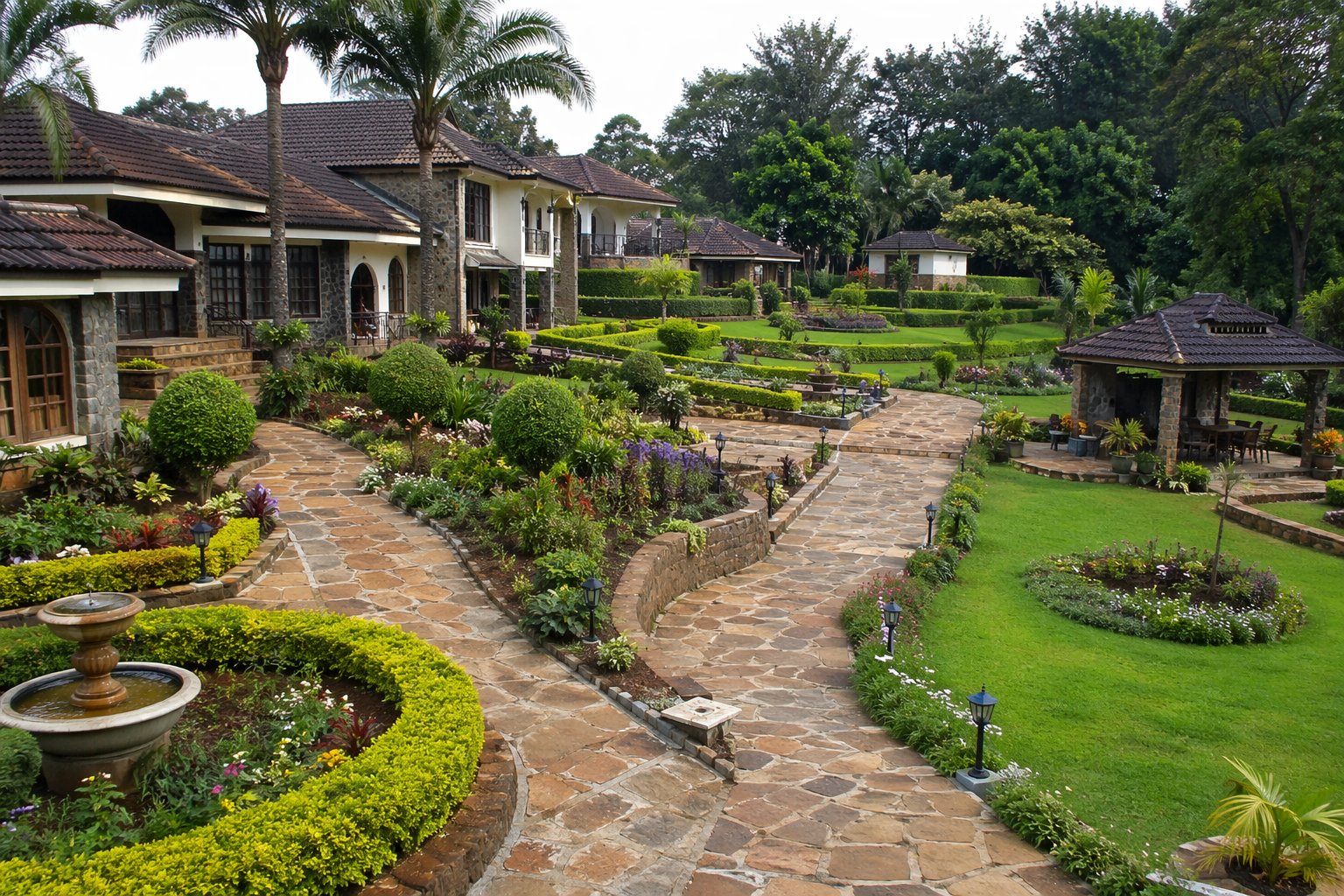
transformed before we dig
We produce a photorealistic 3D layout of your entire compound — driveways, planting, lawn zones, gazebo position, and lighting — before a single seed is planted. Every AALIS consultation includes a free concept design.
Compound Design Styles Popular in Kenya 2026
The right design style for your compound depends on your aesthetic preferences, your house's architectural character, how much ongoing maintenance you want, and your climate zone. These four styles dominate AALIS compound projects in 2026 — each with a distinct visual language and maintenance profile.
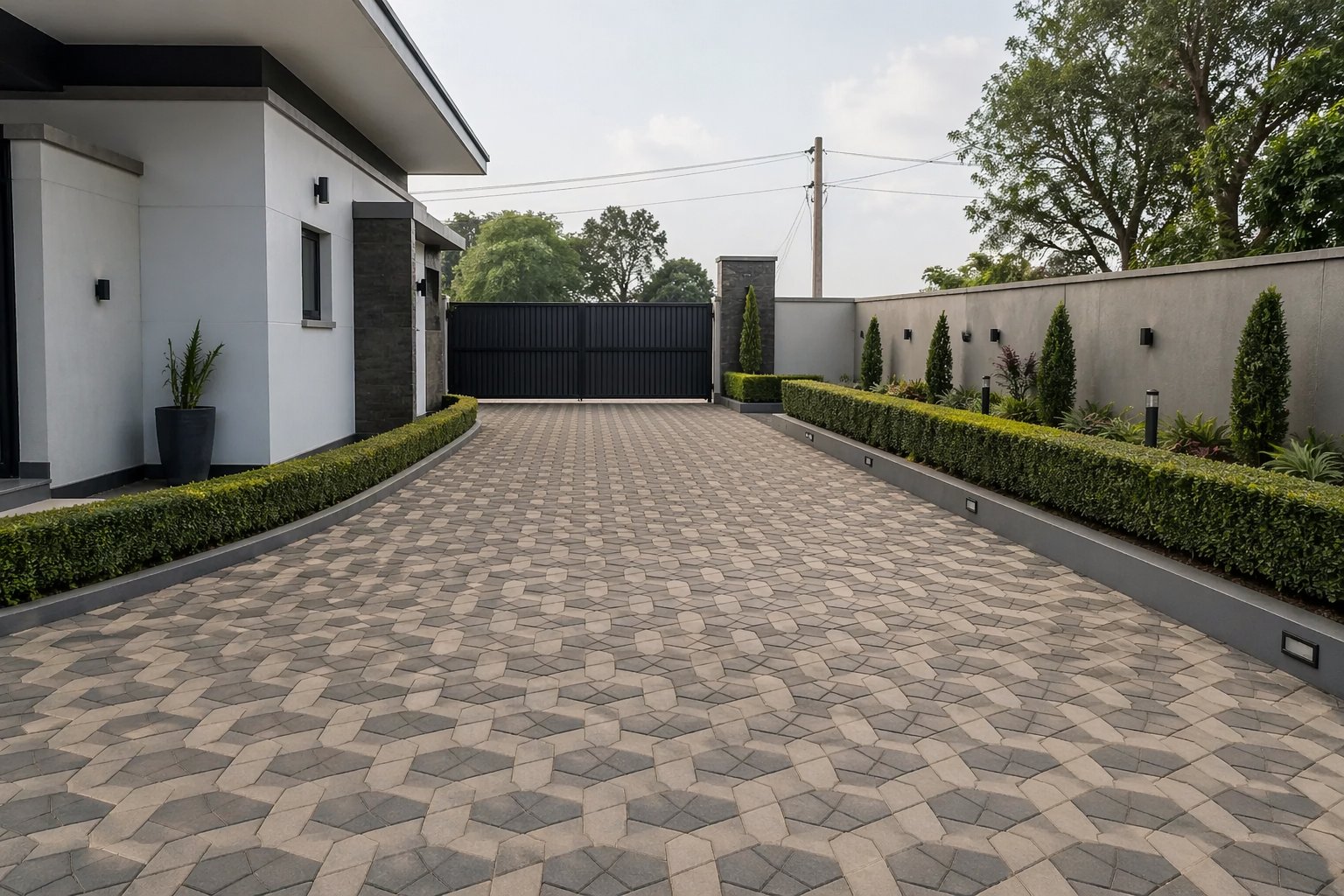
Geometric cabro patterns, gravel beds, structured low hedging, and curated specimen plants. Clean lines, minimal clutter, and a sophisticated hotel-like appearance. Popular in Kilimani, Westlands, Lavington, and modern Ruiru estates. Low maintenance — the structured nature means less weeding and trimming. Artificial turf is a popular inclusion for a permanently manicured look without irrigation cost.
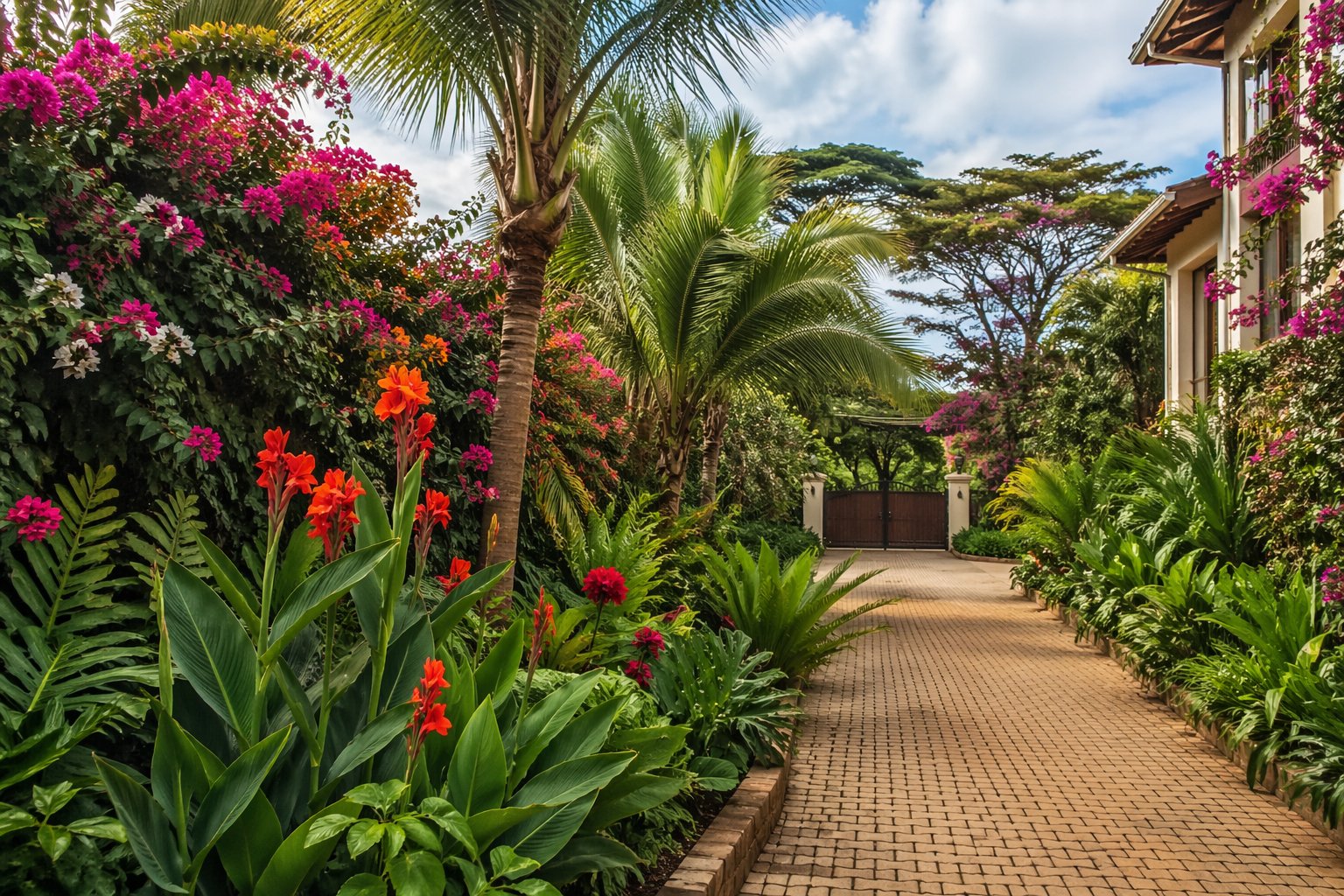
Layered planting — canopy trees, mid-level flowering shrubs, and dense ground-level cover — creates an immersive, resort-like garden. Palms, bird-of-paradise, philodendrons, bougainvillea, and cannas are the palette. Ideal for Karen, Runda, and coastal properties. Requires more maintenance but delivers extraordinary visual impact. The most photogenic style — essential for Airbnb properties where listing photos drive bookings.
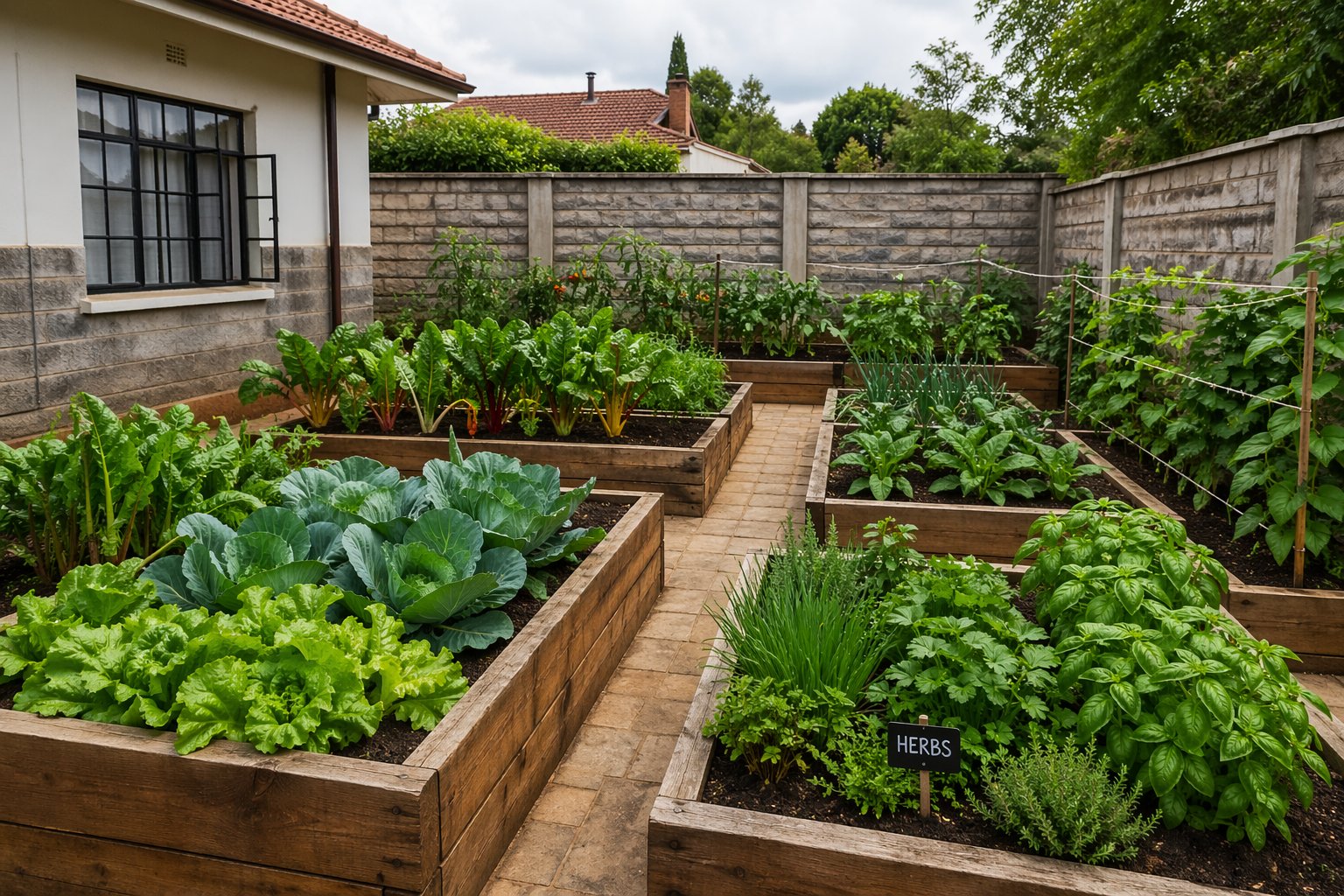
Integrates edible plants — passion fruit on trellises, raised beds for sukuma wiki, herbs, tomatoes, and beans — with ornamental planting and structured pathways. Combines beauty with daily utility, reduces household food costs, and creates a deeply satisfying daily connection with the outdoor space. Increasingly popular across all income levels. Kitchen gardens are particularly well-suited to Kenya's climate and soil.
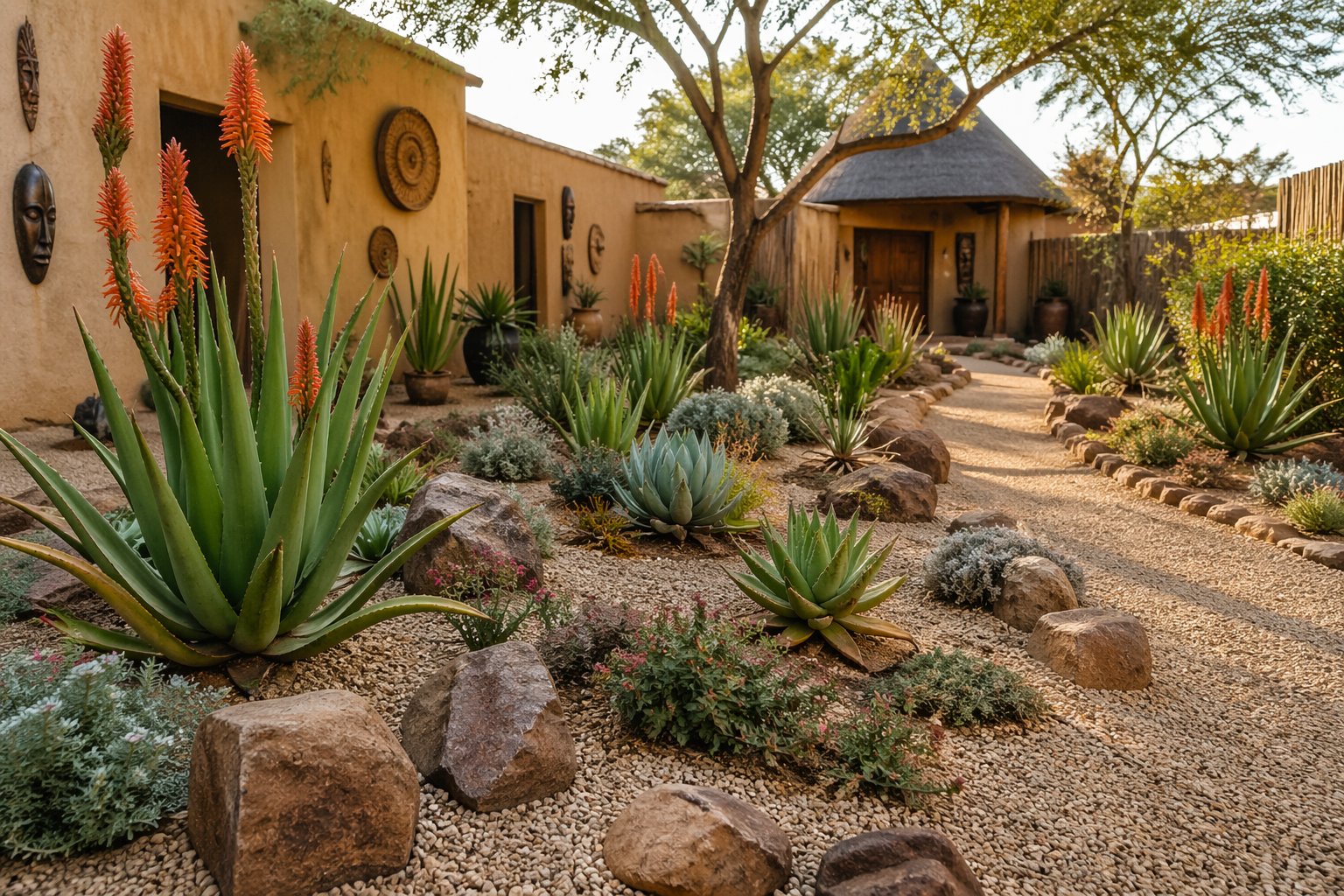
Indigenous Kenyan plants — aloe vera, succulents, crotons, native grasses, and thorny shrubs — combined with gravel mulching and minimal irrigation. The most ecologically responsible approach, requiring the least water and maintenance. Ideal for water-scarce areas, large rural plots, and homeowners who want a beautiful compound without ongoing weekly maintenance cost. Increasingly popular in Laikipia, Kajiado, and semi-arid areas.
Best Plants for Compound Landscaping in Kenya — 2026 Guide
Plant selection determines whether your compound looks beautiful year-round or struggles through Kenya's dry seasons. The plants below are proven performers across Kenya's most common residential climates, chosen for their drought tolerance, visual impact, and low maintenance requirements.
| Plant | Type | Best Use | Best Climate | Approx. Cost |
|---|---|---|---|---|
| LAWN OPTIONS | ||||
| Arabica Grass | Lawn | Formal lawn, cool feel | Nairobi highlands | KES 250–400/m² |
| Kikuyu Grass | Lawn | Hardy all-purpose lawn | All Kenya | KES 200–350/m² |
| Artificial Turf | Lawn | Zero-maintenance green | All Kenya | KES 1,200–2,500/m² |
| BORDER & ORNAMENTAL PLANTS | ||||
| Bougainvillea | Flowering | Hedging, borders, trellises | All Kenya | KES 150–400 |
| Crotons | Shrub | Colourful borders, low hedge | All Kenya | KES 100–300 |
| Canna Lily | Flowering | Entry beds, statement border | Highlands + coast | KES 350 |
| Hibiscus | Flowering | Entry garden, colour accent | All Kenya | KES 200–500 |
| Agapanthus | Perennial | Border, blue flowers, reliable | Highlands | KES 150–300 |
| Lantana | Flowering | Ground cover, attracts birds | All Kenya | KES 100–200 |
| Aloe Vera | Succulent | Rock gardens, dry borders | All Kenya | KES 50–200 |
| TREES & HEDGING | ||||
| Kei Apple | Live Hedge | Security perimeter hedge | All Kenya | KES 200–600/m run |
| Jacaranda | Shade Tree | Focal point, seasonal purple | Highlands | KES 1,000–3,000 |
| Nandi Flame | Flowering Tree | Boundary, shade, impact | All Kenya | KES 1,000–2,500 |
| Avocado | Fruit Tree | Edible landscaping, shade | Highlands | KES 500–1,500 |
| Mango | Fruit Tree | Shade, long-term value | Midlands + coast | KES 500–2,000 |
| Climbing Jasmine | Climber | Wall/trellis, fragrance | All Kenya | KES 200–400 |
Avoid Eucalyptus trees on residential plots in Kenya. Eucalyptus consumes enormous amounts of water, depletes surrounding soil moisture, and its aggressive root system cracks drainage pipes, boundary walls, and house foundations. Remove any existing eucalyptus within 15m of the house before landscaping begins. Replace with a Nandi Flame, Jacaranda, or fruit tree at the same location.
Compound Landscaping Costs in Kenya 2026 — Full Breakdown
The most common question we receive is: "How much will my compound landscaping cost?" The answer depends entirely on your plot size, the elements you include, and the finish level you choose. The table below gives you verified 2026 market rates for every common landscaping element in Nairobi and Kiambu County.
| Element | Unit | Low | High | Notes |
|---|---|---|---|---|
| HARDSCAPING | ||||
| Cabro block paving | per m² | KES 1,200 | KES 2,800 | Incl. blocks, base, labour |
| Red clay brick paving | per m² | KES 800 | KES 1,400 | More affordable; warm look |
| Mazeras stone pathway | per m² | KES 800 | KES 1,800 | Natural finish; garden paths |
| Concrete screed (compound) | per m² | KES 400 | KES 900 | Basic sealed surface |
| Retaining wall (stone/block) | per m² | KES 1,500 | KES 4,000 | For sloped plots |
| SOFT LANDSCAPING | ||||
| Arabica / Kikuyu lawn | per m² | KES 250 | KES 600 | Incl. soil prep and levelling |
| Artificial turf | per m² | KES 1,200 | KES 2,500 | 5–8 year lifespan |
| Border planting (per m²) | per m² | KES 500 | KES 2,000 | Plants + soil + mulch |
| Hedge installation | per linear m | KES 500 | KES 1,500 | Plants + soil prep |
| Tree planting (mature) | per tree | KES 1,000 | KES 3,000 | Incl. compost and staking |
| Kitchen garden raised beds | unit | KES 15,000 | KES 60,000 | Timber or brick; size-dependent |
| FEATURES & INFRASTRUCTURE | ||||
| Solar pathway lighting (set) | set of 6 | KES 8,000 | KES 35,000 | Spike or bollard style |
| Drip irrigation system | unit | KES 25,000 | KES 120,000 | Sized to garden area |
| Water feature / fountain | unit | KES 40,000 | KES 200,000 | Wall-mounted to pond |
| Timber pergola (4×4m) | unit | KES 80,000 | KES 200,000 | See Pergola page |
| Timber gazebo (4×5m) | unit | KES 150,000 | KES 400,000 | See Gazebo page |
| Landscape design consultation | flat fee | KES 10,000 | KES 50,000 | Incl. 3D layout; deducted from project |
| Full 50×100 mid-range compound | KES 200,000 | KES 500,000 | Cabro + lawn + planting + lighting | |
Prices above are Nairobi and Kiambu market estimates for April 2026. Coastal and remote upcountry locations add 10–20% due to transport costs. Always obtain at least 3 itemised quotations before committing. Aalis Studios provides free project quotations with every consultation.
AALIS Compound Design Packages — Three Tiers
At Aalis Studios we do not quote generic landscaping jobs. We design complete compound transformations — treating your outdoor space as a continuation of your architecture, not an afterthought. Every package includes a free 3D compound layout and itemised BOQ before any work begins.
– 200K
- ✓ Stone or gravel pathway (gate to door)
- ✓ Lawn installation (Arabica or Kikuyu)
- ✓ Perimeter hedge planting
- ✓ Entry flower beds + border plants
- ✓ 6 solar pathway lights
- ✓ Free 3D layout + BOQ
- – No permanent structures
- – No cabro paving
– 600K
- ✓ Cabro-paved driveway + stone paths
- ✓ Central lawn area
- ✓ Timber gazebo or pergola
- ✓ Live hedge + ornamental borders
- ✓ Kitchen garden with raised beds
- ✓ Solar lighting throughout
- ✓ Feature tree planting
- ✓ Full 3D design + site management
+
- ✓ Full architectural compound design
- ✓ Premium cabro + stone hardscaping
- ✓ Custom gazebo + outdoor kitchen
- ✓ Water feature or koi pond
- ✓ Drip irrigation system
- ✓ Fire pit + lounge zone
- ✓ Professional lighting design
- ✓ Full landscape planting plan
"The most common regret we hear from homeowners is: 'I wish I'd done this years ago.' A well-designed compound changes how you feel about your home every single day — the arrival, the morning coffee, the evening gathering. It is the most underleveraged investment in residential property across Kenya."
— Arch. Vincent Abuya, Principal Architect, Aalis Studiosfrom anywhere in the world
We manage the full compound design and installation process remotely — 3D compound layout, BOQ, contractor management, and weekly progress updates via WhatsApp. Trusted by clients in the UK, UAE, USA, Canada, and Australia.
Compound Landscaping by Kenya Region & Climate
Kenya's diverse climate zones require fundamentally different compound landscaping approaches. A Nairobi highland compound needs different plants, drainage design, and materials than a coastal Kilifi property or a Nanyuki highland retreat. Here is the region-by-region guide.
| Region | Climate | Best Lawn | Best Border Plants | Key Design Notes |
|---|---|---|---|---|
| Nairobi & Kiambu Karen, Runda, Ruiru, Kilimani |
Temperate highland; two rainy seasons | Arabica or Kikuyu | Bougainvillea, Jacaranda, Canna Lily, Agapanthus | Drainage slope critical on all cabro. Black cotton soil zones need deeper footings for walls and structures. |
| Central Highlands Tigoni, Limuru, Nyeri |
Cool, fertile, reliable rainfall | Kikuyu or English Ryegrass | Roses, Lavender, Hydrangeas, Cypress hedging | Cottage garden style works beautifully. Timber features suit the aesthetic. Good drainage essential on steep plots. |
| Laikipia / Nanyuki | Cool; dry seasons; cold nights | Kikuyu (drought-tolerant) | Aloe, indigenous shrubs, Agapanthus, Nandi Flame | Drip irrigation needed in dry months. Fire pit in garden is essential. Xeriscaping reduces maintenance and water cost. |
| Rift Valley Naivasha, Nakuru, Kijabe |
Variable highland climate | Kikuyu grass | Bougainvillea, Jacaranda, indigenous trees | Views should anchor the design layout. Lakeside properties (Naivasha) benefit from water features that echo the landscape. |
| Coast Mombasa, Diani, Kilifi, Malindi |
Hot, humid, salt air, heavy rains | Buffalo grass or Bermuda | Palms, Frangipani, Bougainvillea, Coconut, Baobab | Use galvanised or aluminum hardware only. Coral stone paths. Open-sided structures essential for air flow. Shade planting critical. |
| Arid / Semi-arid Machakos, Kajiado, Kitui |
Hot, dry, high UV | Artificial turf or gravel | Aloe, succulents, indigenous thorny shrubs | Shade structures are not optional. Drip irrigation essential. Replace lawn with gravel and ground-cover plants. Rainwater harvesting valuable. |
6 Common Compound Landscaping Mistakes in Kenya
Every compound landscaping project in Kenya must begin with a drainage assessment. Cabro paving installed without a proper slope, or planting beds positioned in natural drainage channels, creates flooding in every rainy season. The cost of correcting drainage after construction is 3–5x higher than designing it correctly from the start. Every paved surface must have a minimum 1–2% slope directing water away from the house and towards a drainage channel or soak pit.
Still one of the most common mistakes across Kenyan compounds despite being well-documented. Eucalyptus roots extend aggressively, crack pipes, undermine foundations and boundary walls, and deplete all soil moisture in the surrounding area. Nothing grows under or near a eucalyptus tree once it is established. Remove any eucalyptus within 15m of the house before beginning any landscaping work. Replace with a Nandi Flame, Jacaranda, Avocado, or Mango at the same location.
Many homeowners invest in exotic plant species — topiary hedges, Mediterranean herbs, expensive palms — that require constant irrigation, specialist care, and regular replacement in Kenya's climate. Indigenous drought-tolerant species establish faster, cost less, survive Kenya's dry seasons without irrigation, and look equally — often more — beautiful. Use exotics as accents; make indigenous species the backbone of the planting scheme.
The sequence of a compound design project matters critically. Paving — cabro, concrete, or stone — must be completed before any planting begins. Paving work requires heavy machinery, excavation, and materials that will destroy any existing planting. The correct sequence is always: drainage → paving → structures → planting → lighting. Starting planting first and paving later guarantees damaged or destroyed plants and wasted cost.
Kenya has two dry seasons per year (June–August and October–December). A beautifully planted compound that browns and wilts every dry season is a poor investment. At minimum, install outdoor tap points at strategic compound locations before landscaping begins — adding them retrospectively requires breaking paving or running visible pipes. A basic drip irrigation system (KES 25,000–80,000) automates watering and keeps the compound looking its best year-round.
Compound landscaping does not have to happen all at once, and trying to do everything simultaneously on a tight budget produces a compound where everything is mediocre rather than some things being excellent. A phased approach — paving and paths first, then lawn and hedging, then planting and features, then structures — allows budget management without sacrificing the overall vision. A 3D design at the start ensures each phase contributes to the finished result rather than requiring expensive corrections.
— see it before we build it
Tell us your plot size, location, and budget. We will send you a photorealistic 3D layout of your compound transformation and an itemised quote within 48 hours.